

“Meditate for three months and your cortex grows by 0.1 millimeters” sounds scientific because it uses a precise number. The evidence is less precise.
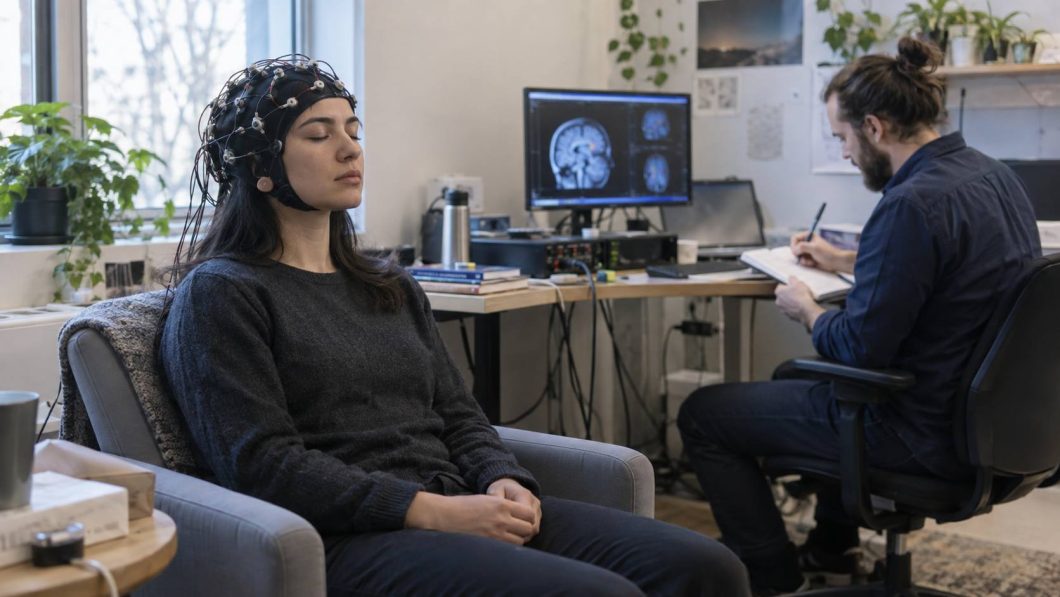
Small studies have reported changes in brain regions linked with memory, body awareness, and self-related processing. One study of 16 beginners found gray-matter concentration changes after an eight-week mindfulness program. But brain-imaging measures are complex, and a result from a small sample is not a promise for everyone.
A larger analysis of two randomized trials, including 218 beginners, found no evidence that eight weeks of mindfulness changed gray-matter volume, density, or cortical thickness more than the comparison conditions. This does not mean meditation does nothing; it means “a thicker brain in a fixed time” is not a reliable headline.
Behavioral findings are often more useful. A randomized study found that five days of integrative body-mind training improved aspects of attention and stress regulation. Other trials suggest that acceptance—seeing an experience without immediately fighting it—helps explain some emotional benefits.
Think of meditation as training attention, body awareness, and response flexibility. Practice ten to twenty minutes most days, use the breath as an anchor, treat distraction as part of the exercise, and evaluate change in daily life: Do you recover from stress faster? Can you notice a thought before it becomes an action?
Meditation does not need miracle marketing. The honest claim is stronger: the mind and brain can learn, but effects vary, take time, and should be measured by how we live.
Scientific Sources:
- Hölzel BK, et al. (2011). *Mindfulness practice leads to increases in regional brain gray matter density.* PubMed
- Kral TRA, et al. (2022). *Absence of structural brain changes from mindfulness-based stress reduction: Two combined randomized controlled trials.* PubMed
- Tang YY, et al. (2007). *Short-term meditation training improves attention and self-regulation.* PubMed
- Lindsay EK, et al. (2018). *How mindfulness training promotes positive emotions: Dismantling acceptance skills training in two randomized controlled trials.* PubMed
- Lindsay EK, et al. (2018). *Acceptance lowers stress reactivity: Dismantling mindfulness training in a randomized controlled trial.* PubMed
- Feldman G, et al. (2010). *Differential effects of mindful breathing, progressive muscle relaxation, and loving-kindness meditation on decentering and negative reactions to repetitive thoughts.* PubMed