

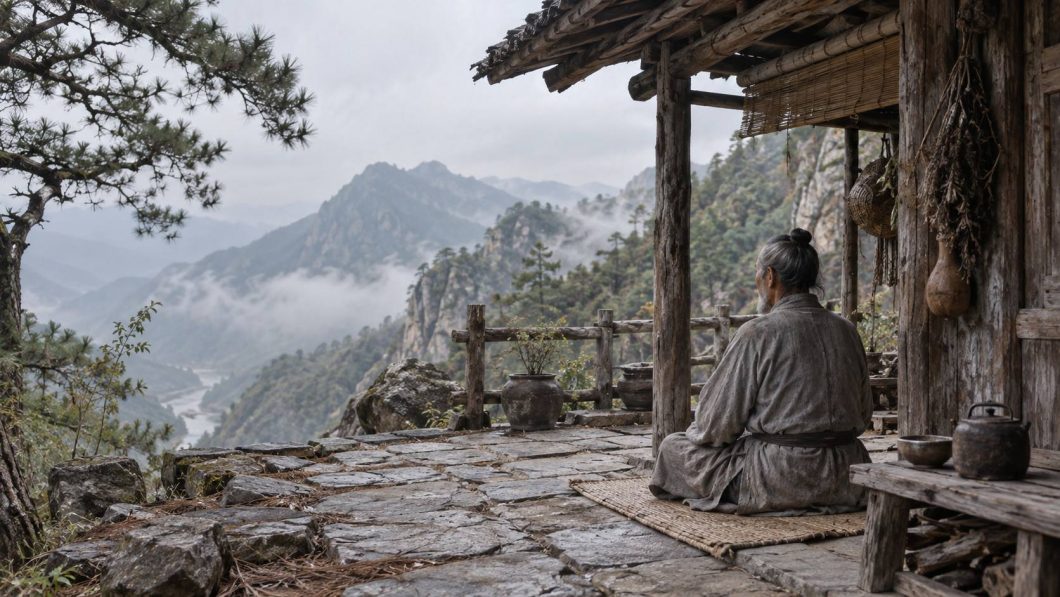
Why did ancient practitioners leave status and comfort to sit in temples or mountains? Beyond the language of immortality, they had noticed a familiar human problem: the mind can become so busy managing life that it forgets how to experience it.
Taoist language sometimes contrasts *yuanshen*, the “original spirit,” with *shishen*, the acquired, discriminating mind. In the language of ancient cultivation, the *yuanshen* is the higher self we are born with—the clear inner awareness beneath the noise of acquired habits. These are spiritual metaphors, not brain structures. They resemble a modern distinction between awareness and the stream of learned stories, fears, comparisons, and plans.
The acquired mind is useful. It learns, predicts, and protects us. It becomes exhausting when its commentary fills every moment. We replay conversations, rehearse disasters, compare ourselves with edited images, and mistake the noise for the whole self.
Meditation interrupts that automatic rule. Stillness reduces stimulation; the breath gives attention a home; noticing thoughts without completing them creates distance between awareness and mental content. Psychology calls a related ability “decentering”: seeing a thought as an event rather than an order.
Sit for twelve minutes: four minutes with the breath, four watching thoughts come and go, four asking quietly, “What knows this thought?” Do not search for a mystical answer. Return from the story to the knowing of the story.
The ancient mountain can now be a closed door and an airplane-mode phone. The setting has changed; the task has not. Meditation does not destroy the thinking mind. It returns that mind to its proper role: a capable servant within a wider field of awareness.